







Symbiotic Sovereignty: Master Engineering the Living City in The Wandering Village
The Wandering Village is a masterclass in ecological management, presenting a unique logistical challenge: your city is built on the back of a colossus. Unlike traditional city builders where the terrain is static, The Wandering Village operates on a principle of "Bio-Logistics." You aren't just managing resources; you are managing a relationship with Onbu, the massive six-legged creature carrying your civilization through a post-apocalyptic world. To survive the high-difficulty "Expert" runs, a Governor must move beyond basic farming and master the nuances of Onbu’s physiology, the fungal toxicity of the air, and the complex interplay between symbiotic trust and parasitic survival. This guide provides a deep-dive into the technical systems required to transform a fragile outpost into a permanent, thriving ecosystem atop a living god.
1. The Onbu Physiology: Understanding Your Living Foundation
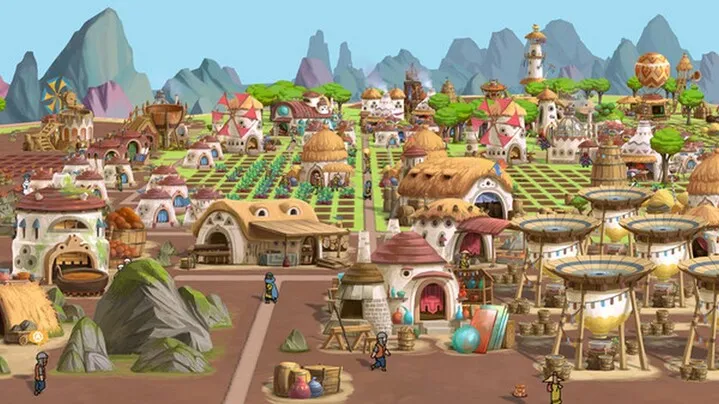
The core of The Wandering Village is the Onbu’s health and trust metrics. These are not just flavor text; they are the primary constraints of your city’s expansion. Every action you take—harvesting stones from Onbu’s back, extracting blood for food, or commanding it to run through a toxic cloud—affects its metabolism. A high-level strategy involves monitoring Onbu's "Heart Rate." When Onbu is tired, its movement slows, and its hunger increases. If you push it too hard without rest, it will eventually collapse, leading to an immediate game over as your village is reclaimed by the spores.
Trust is the currency of autonomy. If Onbu trusts you, it will follow your commands at crossroads and lie down when signaled. If trust is low, it will act independently, often walking directly into Spore Clouds or heatwaves. To master the early game, you must prioritize the Onbu Kitchen. Feeding Onbu "Quality Food" (Great Onbu Food) rather than raw cactus or beets is the most efficient way to farm trust. This relationship is a feedback loop: a happy Onbu is a controllable Onbu, which allows you to navigate away from hazards that would otherwise decimate your population.
2. Spatial Optimization: The "Bio-Grid" Layout Strategy
Space on Onbu’s back is the most precious resource. You cannot "build out"; you can only "build smart." The grid is limited by Onbu’s spikes and the "Inhabitable Zone." To maximize efficiency, you must implement a Zoned Production Hub. Place your water-heavy buildings (Farms, Berry Gatherers) near the center to minimize the travel time of water carriers. Your industrial buildings (Stone Mines, Sawmills) should be pushed toward the edges or near the Onbu’s head/tail where resource nodes are most common.
Industrial Proximity Buffs
- The Kitchen-Canteen Axis: Place your kitchens directly adjacent to your housing blocks. This reduces the time workers spend "commuting" for food, increasing their active work hours by up to 15%.
- Water Tank Buffering: Never rely on a single large water tank. Instead, use a "Cellular Network" of small tanks placed at the corners of your farm plots. This ensures that even during a drought, your farmers have immediate access to irrigation without walking halfway across the map.
- The Dung Pit Loop: Position your Dung Collectors near your Compost Heaps. This minimizes the travel time for fertilizer production, which is essential for surviving the "Withered" biomes.
3. Atmospheric Defense: Managing the Spore Menace
Spore Clouds are the "invading army" of The Wandering Village. When Onbu walks through a cloud, spores land on the ground and begin to grow into toxic plants. If left unchecked, these plants will spread and destroy your buildings. The technical solution is the Decontaminator Network. Decontaminators use fuel (biogas) to burn away spores. A rookie mistake is waiting for the spores to land; a pro-tier move is to set your Decontaminators to "Aggressive" before entering the cloud, ensuring your workers are ready to torch the plants the moment they sprout.
Spore Mitigation Checklist
- Air Filters: Research and build Air Filters near the Onbu’s head. This reduces the density of the cloud before it reaches your residential zones.
- Biogas Efficiency: Always have a dedicated "Dung to Biogas" pipeline. Without fuel, your Decontaminators are useless, and a single missed spore cloud can end a run in ten minutes.
- The Scavenger Priority: When spores are present, set all Scavenger Huts to "Collect Spores" only. Removing the physical threat is more important than gathering wood or stone.
4. Hydraulic Sovereignty: Mastering Water in Extreme Biomes
Water management is the most complex logistical chain in the game. You transition between Humid, Arid, and Toxic biomes, each affecting your water intake. In the Desert, your Air Well production drops to nearly zero. To survive, you must master Cactus Farming and Seawater Desalination. Cactus provides a "Wet" resource that can be processed into water, but it requires specialized "Desert Farmers" who work slower in high heat.
The late-game solution is the Desalination Plant, located near the Onbu’s tail. This allows you to process ocean water during coastal journeys. However, desalination requires massive amounts of power. You must balance your Wind Turbines with your water needs. A common "Expert Mode" strategy is to stockpile at least 500 units of water before entering a Desert biome, effectively "pre-gaming" the drought so your farms don't wither during the 10-day trek.
5. The Parasitic Dilemma: Blood, Bile, and Bone Extraction
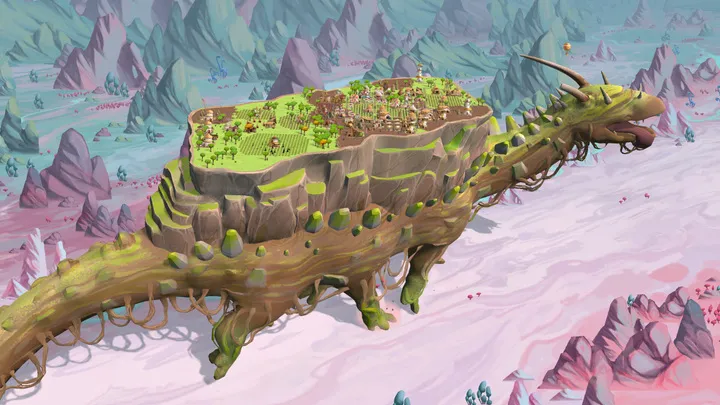
At a certain point, the survival of your village may conflict with the health of Onbu. You can build buildings like the Blood Extractor or the Bile Extractor. These provide high-tier resources (Blood for food, Bile for medicine) but cause physical pain to Onbu, lowering health and trust. The technical nuance is "Controlled Parasitism." If your population is starving, extracting a small amount of Onbu blood can save the village, but you must immediately follow it up with an Onbu Pharmacy treatment to heal the wound.
Extraction Resource Values
- Onbu Blood: Used as a high-protein ingredient in the Kitchen. Most efficient when Onbu health is above 80%.
- Onbu Bile: Essential for crafting high-tier antidotes. Use only during "Fungal Outbreaks."
- Onbu Stone (Spikes): A finite resource on Onbu’s back. Do not over-harvest, as these spikes act as natural "Windbreaks" that slightly protect your crops from storm damage.
6. Onbu Pharmacy: Advanced Veterinary Logistics
Keeping Onbu alive is more than just feeding it; you must play the role of a giant veterinarian. The Onbu Pharmacy produces medicines that cure "Toxic Poisoning" and "Wounds." The production of these medicines requires Herbalism and Alchemy. You must dedicate at least 10% of your farm space to "Herbs," which cannot be eaten but are the only way to craft the medicine needed to survive the Spore Biomes.
Strategic medical intervention involves "Proactive Healing." Don't wait for Onbu's health to drop to 20%. If Onbu is poisoned (indicated by a green tint on its skin), its metabolism will burn through food 2x faster. By applying an Antidote early, you save more resources in food than you spent in medicine. This "Resource Conversion" is the hallmark of a high-level player.
7. The Scavenging Meta: Resource Acquisition in the Wasteland
Since the space on Onbu’s back is limited, many of your advanced resources must come from the world below. The Scavenger Hut allows you to send teams to explore ruins, forests, and quarries. The technical trick is Team Specialization. Don't send a general team; send specialized scavengers based on the biome. In ruins, send teams with high "Technical Skill" to find blueprints; in forests, send "Foragers" for extra wood.
Scavenging Priority List
- Blueprints: Non-negotiable. You cannot progress to Tier 3 buildings without them.
- New Villagers: Only scavenge for people if you have a food surplus. An unexpected population boom can trigger a famine.
- Knowledge Shards: Used in the Research Tree. These are the most valuable mid-game resources for unlocking the "Onbu Command" abilities.
8. Navigational Control: Steering the Colossus
Eventually, you will unlock the Onbu Command Center. This allows you to "Suggest" a direction at crossroads. Success depends on Onbu’s trust. If trust is at "Devoted," the chance of success is 100%. Steering is your most powerful defensive tool. You can avoid Spore Clouds entirely by taking a longer route through an Arid biome, or you can steer toward "Shrines" that provide massive bonuses to research speed.
Advanced steering involves "Path-Tracing." Look at the world map 3-4 crossroads ahead. If you see a massive Spore Forest, you need to start banking trust and food now. You might choose to lie Onbu down in a "Rest Stop" (a safe zone) for two days to ensure it has enough energy to "Sprint" through the danger zone later. Managing Onbu's stamina is as important as managing your villagers' hunger.
9. Research Architect: The Tech Tree Progression Path
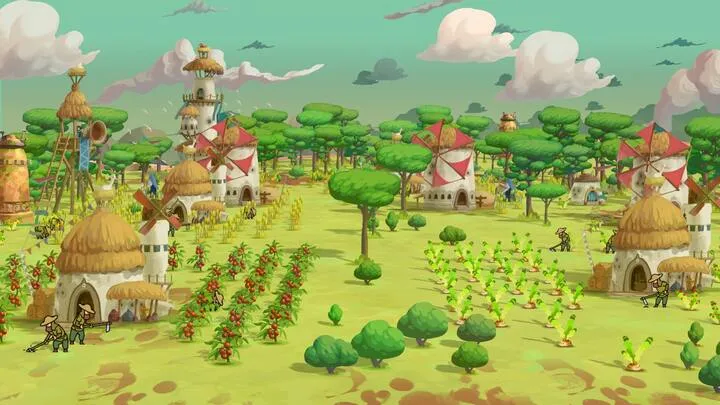
The Research Tree in The Wandering Village is a trap for the uninitiated. Many players rush for "Better Houses," but the real power lies in Logistical Automation. Prioritize the "Water Pipe" and "Transporter" techs. These automate the movement of water and resources, freeing up your villagers to focus on specialized tasks like decontaminating or scavenging.
Tiered Research Goals
- Early Game: Air Wells, Onbu Kitchen, Scavenger Hut.
- Mid Game: Compost Heap, Onbu Pharmacy, Biogas Plant.
- Late Game: Desalination, Large Onbu Kitchen, Automated Transporters.
- Emergency: If you find yourself in a Spore Forest without "Flamethrowers," drop all research and focus on "Spore Defense" immediately.
10. The Eternal Cycle: Achieving a Self-Sustaining Colony
The "End Game" of The Wandering Village is reaching a state of Closed-Loop Ecology. This is where your Dung Collectors provide enough fertilizer for your farms, your Air Wells provide enough water for your villagers, and your Onbu Kitchen provides enough food to keep Onbu permanently happy. In this state, the village is no longer "surviving"—it is thriving. This requires a perfect balance of population to resource output.
To achieve this, you must strictly control your population. Every new villager adds a permanent "Tax" on your water and food. A common late-game mistake is accepting too many refugees. A population of 60-80 villagers is often the "Sweet Spot" for a self-sustaining Onbu. Once your systems are automated, you can focus on the "Monument" buildings, which serve as the final victory condition for the game, marking your village as a permanent fixture of the new world.
Conclusion
The Wandering Village is a complex dance between a parasite and its host, a delicate balance where the floor you walk on is as alive as the people you lead. Mastery is not found in exploiting Onbu, but in harmonizing with it. By understanding the metabolic costs of movement, the logistical necessity of water stockpiling, and the technical precision of decontaminating spore outbreaks, you transform a desperate struggle into a majestic journey. The colossus is not just a platform; it is your greatest ally. Treat it with respect, manage its health with scientific rigor, and your village will wander the world long after the spores have claimed the rest of history.